

🧠 Is my Child Twice Exceptional or 2e?
Before we begin
On a personal note, I absolutely love working with 2e, twice-exceptional kids. I often say, “the more complex the kid, the better”, because 2e kids are truly the most interesting people I know. They tend to be intellectually deep, incredibly creative, emotionally intense, quirky, and when they get their educational needs met, they do really cool things as adults. Many of the people who “change the world” were twice-exceptional kids. They’re just super cool people, and too many of them fall through the cracks because they are misunderstood.
Adults don’t always understand their strengths and/or challenges. In fact, strengths and challenges often mask each other. Consequently, rather than figuring out what these kids need to thrive, they are often shamed with ignorant messages like, “you’re lazy”, “you don’t try hard enough”, “you don’t care enough about school”, “you just need to be more disciplined and motivated”. These shame comments don’t help, they hurt, and many of these kids internalize the messages and begin to feel like they are not enough, that they are stupid, that they are failures, or that they are broken.
I happen to see these kids as the most important game-changers for creatively solving the world’s future problems, and it’s particularly important to society as a whole that these kids get the education they need. Now let’s dive in…
What is 2e or Twice Exceptional?
Generally speaking, twice exceptional, or 2e students, are both intellectually gifted & talented and learning disabled. In the education world, giftedness and learning disabilities are both considered “exceptionalities”, so the term “twice-exceptional” refers to a student with exceptionalities on both sides of the proverbial bell curve. In a nutshell, if you have a child who you know is smart/bright, but who struggles to show it, they may be 2e. About 5% of kids are 2e.
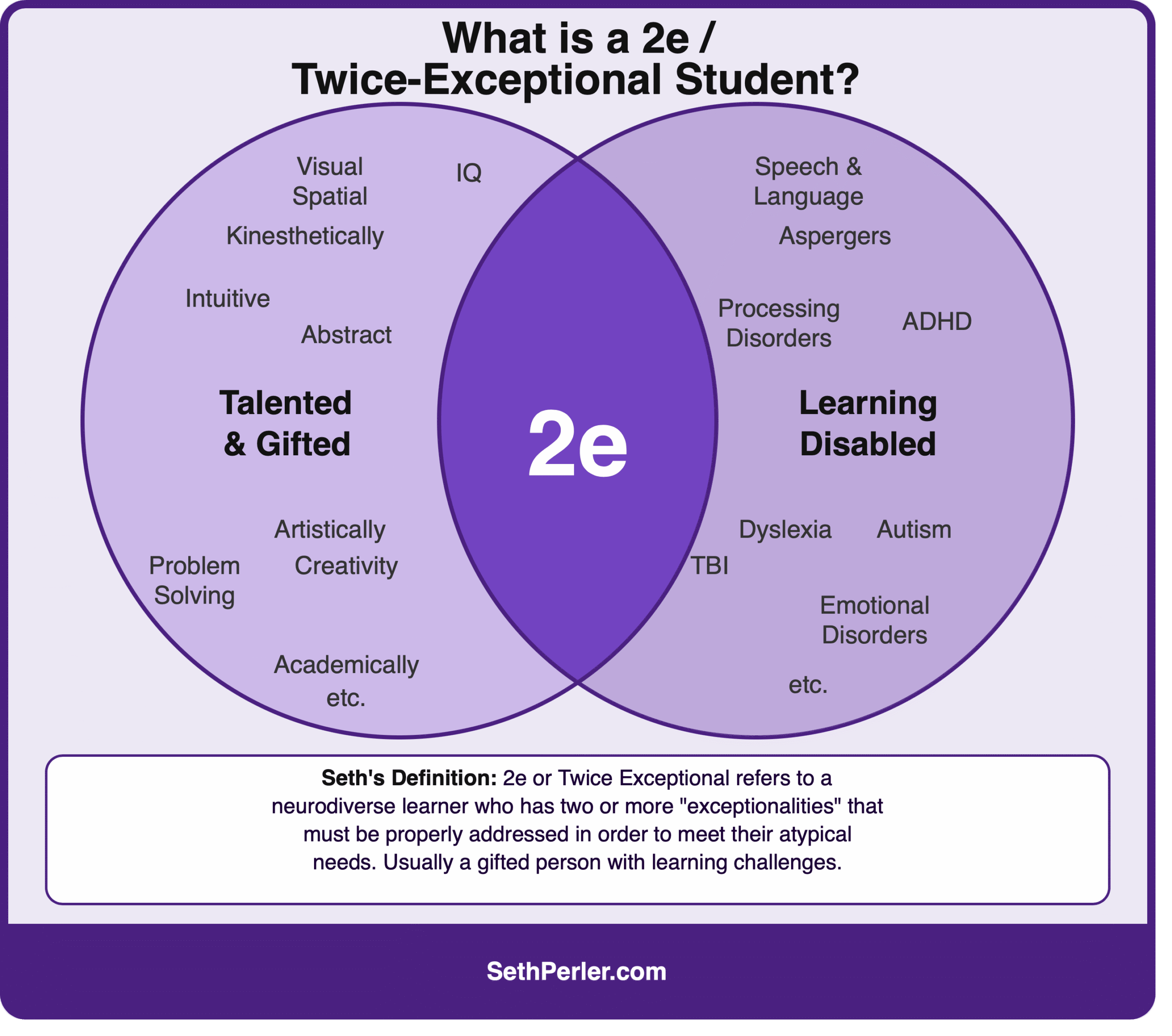
The ‘2e’ abbreviation – People use the abbreviation “2e” for simplicity. It’s used interchangeably with the term “twice-exceptional”.
Multi-exceptional – Many professionals, myself included, prefer the term “multi-exceptional” because of how complex these kids are. Labels like 2e can be misleading because there is often a lot more that needs to be considered when planning to meet the complex educational needs of these kids. For example, it’s not uncommon to have an intellectually gifted child who has also been diagnosed with ADHD, ASD, processing disorders, and an emotional disorder. Unfortunately, teachers rarely know the full story, and even if they do, they are not always given the time, training or resources they need in order to meet the needs of these kids.
Asynchrony – The #1 key concept to help understand 2e learners is asynchrony, aka dyssynchrony. 2E kids tend to develop quite “asynchronously”. They are “all over the place” in terms of grade level ability or age appropriate development. For example, you might have a 6th grader who reads at the 12th-grade level, has the fine-motor handwriting of a 1st grader, writes papers like a 3rd grader, understands math concepts at an 9th-grade level, calculates math facts at a 4th-grade level, can hold remarkably deep conversations with adults, and has temper tantrums like a 3-year-old. You get the picture, the developmental levels of 2e kids aren’t “in sync”. The discrepancies between “potential” and “output” causes many problems.
I read a lot of neuropsychologist reports and it’s not at all uncommon to see a 2e child in the superior range for some metrics and in impaired range for others. For example, a 2e child may be at the 98th %ile for verbal ability, but the 2nd %ile for processing speed. As you can imagine, these discrepancies cause a lot of misunderstandings.
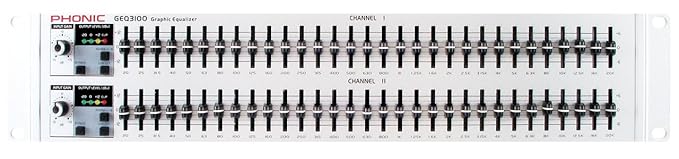
I like to think of asynchrony like an old stereo EQ (see below). Imagine that each slider represents one developmental area. Perhaps one slider represents math, writing, reading, social, emotional, visual-spatial (of course you could break it down into smaller sub-skills if you wanted to). Sliding it up indicates greater ability and down indicates less ability as compared to most peers of a similar age. The image below could describe someone who was “on grade level” since the different domains are all at the same level, they are in sync. Standardized tests for such a child would show average grade level scores (they might be labeled “proficient” on tests). Now imagine an eq for a 2e child where the sliders were all over the place, some average, some very high, some very low. This would represent asynchronous development.
Neuro-typical – When discussing 2e kids, it’s good to be familiar with the term “neurotypical” (a word commonly used in ASD circles, originally used to refer to non-ASD people). This word refers to kids who experience “neurologically typical” development cognitively, socially, emotionally. For example, it might be considered neurotypical to learn multiplication tables in 3rd grade or to be able to write a good research paper by high school. Some would argue that neurotypicals compose 80% of kids in the “middle” of the bell curve. 2e kids are, by their very nature, not neurotypical. I sometimes use the term neuroatypical to refer to 2e kids or other kids who are outside-the-box learners.
Bell curve – Bell curves can be useful when used properly, but the metaphor of the bell curve can cause a lot of misunderstanding. I want to clarify how I think of it so you can have a better understanding to help your kids. The bell curve below is called the “normal bell curve” and the world normally carries a lot of baggage. The problem is that if there are “normal” people than there are “abnormal” people, and that frame can carry a lot of hurtful judgment. I have seen way too many kids who feel like they are broken, who feel like there is something wrong with them, and those feelings can cause a lot of trauma. I wanted to mention this because it’s important that we are careful about the messages we send.
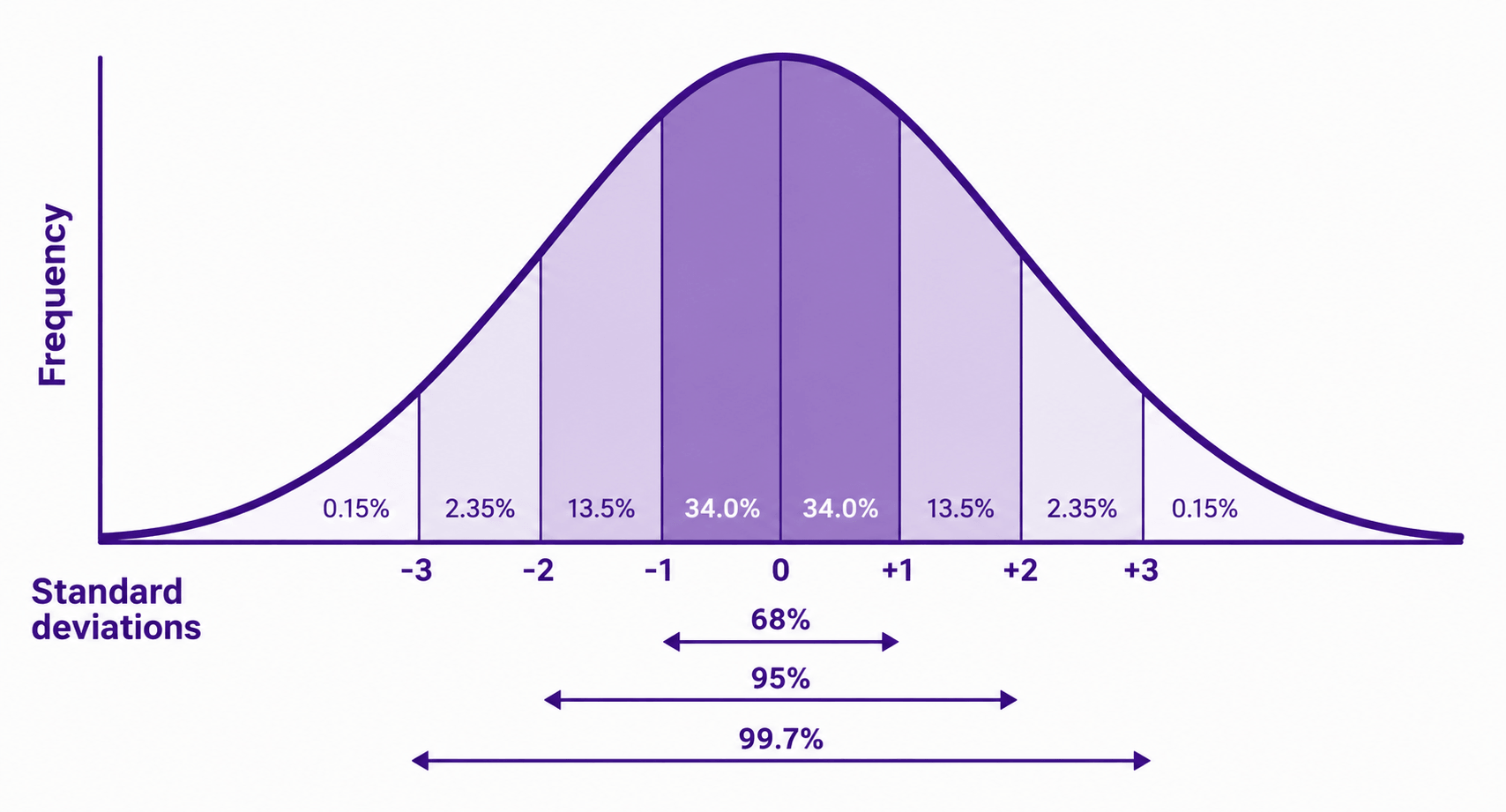
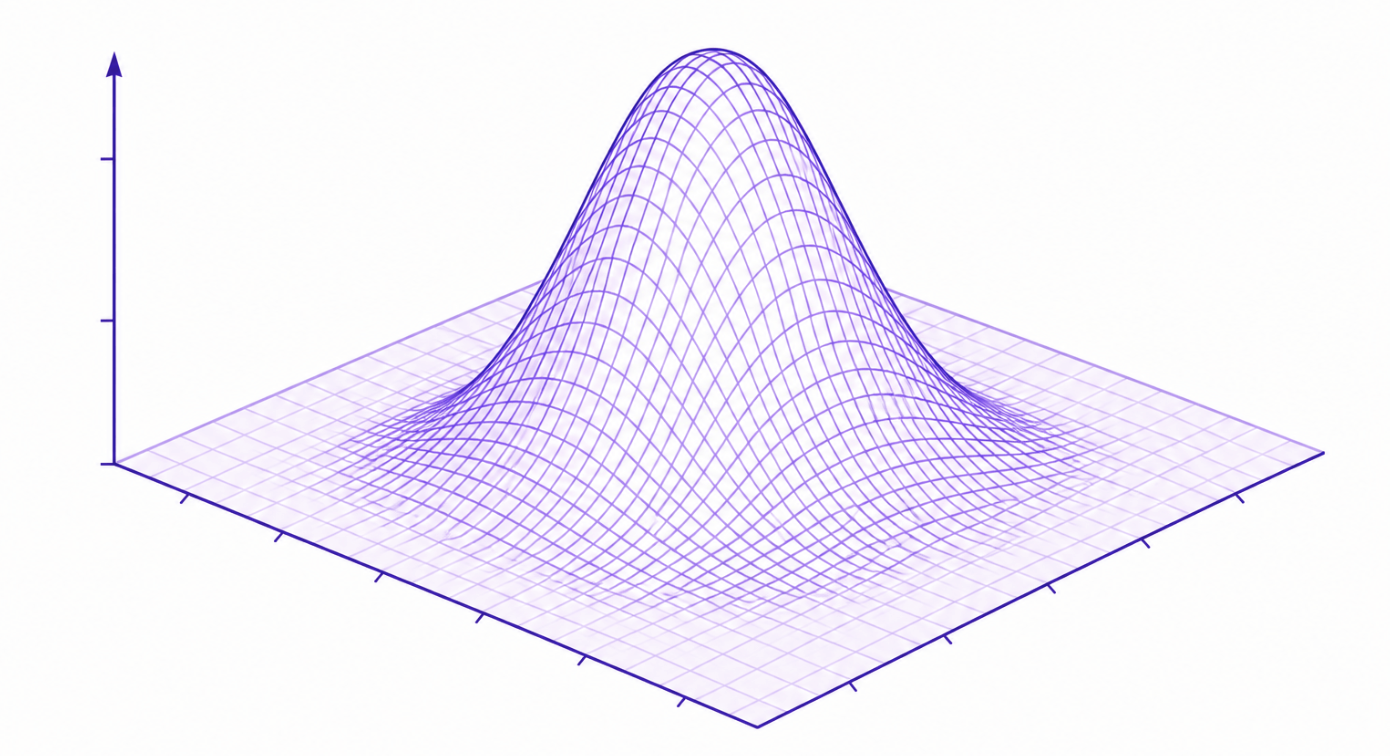
3-d Bell Curve – I think of the normal bell curve as being limited and one-dimensional. In other words, it doesn’t give me nearly enough information about the complexities that make up students. These are human beings with incredibly complex and rich personalities and learning needs. Therefore, I like to think of these metrics as parts of 3-d bells, with countless interrelated qualities. Imagine that you could look at this bell from hundreds of angles to get perspective on various relevant aspects of these kids. It’s so much more interesting and useful.
How do I know if my child is 2E or Twice Exceptional?
It’s critical for parents and teachers to have clarity regarding their Twice Exceptional students because a failure to understand them can have devastating effects. Also, as stated above, adults who don’t understand 2e often use shaming words that are damaging, sending misinformed messages that these kids are lazy, don’t care about school or don’t try hard enough.
Testing for intelligence and learning disabilities – 2e students are “smart but struggling”, so if this describes your child, you should explore this until you feel clear about what’s going on. Generally, parents have a gut feeling about this sort of thing, but many families find clarity through getting professional testing done by a neuropsychologist or other diagnostician who tests for giftedness and learning problems. Schools may also provide testing in order to see if they will offer services.
When parents ask me to refer to someone for testing, the most important factor I consider is how well the diagnostician consults with a family after testing. For example, my favorite neuoropsychologist in Colorado spends a great deal of time with families afterwards so they leave with all of their questions thoroughly answered. I’ve seen too many families come to me with an overwhelming 10-page report that they don’t even know how to read. What good is paying for testing when you don’t understand the results?
Common tests you can research – WISC IV, WAIS III, Stanford Binet, Woodcock-Johnson, DAS, UNIT, Ravens Progressive Matrices, NNAT, K-TEA/NU.
Discrepancies – The difference between what a child should be able to do and their actual execution causes a great deal of problems for these kids. Adults often say things like, “he’s got so much potential, I don’t know why he doesn’t try harder?!?!”. These kids are trying, but it’s often masked. These kids are working very hard using their strengths, abstract reasoning abilities, and intelligence to compensate for their weaknesses, so they are often misunderstood. Unfortunately, the opposite is often true, their challenges can mask their gifts.
Common Learning Disabilities, Differences or Challenges
Don’t let the stigma of the word “disabled” (dis-able) scare you, because what’s most important is that you know the truth about your child’s abilities and needs. Even when there is no formal diagnosis, parents often have an intuition about their child’s “gifts” and “disabilities.” Here are some common differences to look out for:
- Dyslexia
- Dysgraphia – writing disability
- Dyscalculia – math disability
- Processing disorders (sensory – visual, auditory, CAPD)
- ASD, Aspergers, Autism
- Dyspraxia, Sensory integration, fine motor problems
- Dysphasia – problems understanding language
- Speech & language
- ADHD, attentional, executive function
- TBI Traumatic Brain Injury
- Emotional disorders, mood disorders, depression, bipolar, anxiety, OCD, etc.
- Physical disabilities
Types of Gifts to consider
It does not have to be “book smarts,” there are many ways a child can be gifted:
- IQ, GT is often thought of as 130+, 160+ is often considered profoundly gifted
- Academically – math, science, language arts, etc.
- Artistically – art, music, dance, etc.
- Kinesthetically, Athletically
- Verbal ability
- Visual-spatial
- Problem-solving ability, original, unique ideas
- Abstract thinking, flexible thinking, highly creative, insightful
- Gardner’s Multiple Intelligences: musical, interpersonal, intrapersonal, logical-mathematical, linguistic, naturalistic, visual-spatial, bodily/kinesthetic
- Asks unusually deep questions, High-level thinking
- Intuitive or spiritual, “indigo kids”
- Unusually observant in strength areas, learns very quickly in strength areas
- Can communicate in a very mature way (sometimes being incredibly immature at other times)
- Enjoys intellectual challenge
- Advanced sense of humor
- Remembers a lot of details easily
- Crave learning and intellectual stimulation
What are common challenges facing 2e learners
Here’s a list of common problems these leaners face. It is by no means a comprehensive list, but should adequately shed some light on the issue.
- They fall through the cracks, don’t get their needs met, waste years of their adult lives “finding themselves”
- People who don’t understand 2E learners often use ignorant statements like this: “He’s just being lazy”, “She’s not trying her best”, “He doesn’t care enough about school”, “What a shame, she’s got so much potential”, “He needs to be more motivated and disciplined.”
- Compensatory strategies that these kids use can mask the gifts or the legitimate learning differences/disabilities (“masking” can even lead to NOT being diagnosed)
- Discrepancies between strengths and challenge areas can negatively affect how these kids are perceived
- Low grades can mask true ability
- Misperceived as not “gifted enough” for GT services and not “struggling enough” for SPED services, therefore do not get the support they need
- Spend a ton of time and energy to process and do work as compared with peers and often get lower grades regardless of effort
- Schools don’t keep up with the research on 2e and don’t train teachers adequately to serve them
- These kids are often bored, they learn fast and when a school doesn’t accelerate curriculum, these kids disengage
- They can be sick of things that feel like pointless busywork and refuse to do homework
- They often thrive with different aged peers but are kept with same-age peers because of “grade level”
- Can’t take advanced class because they are “underachieving”, causing more boredom and resistance
- Pull out programs may not be adequate
- Pullouts may make them feel different since they are being pulled out of class (middle schoolers hate to look different)
- Sometimes kids in pullout programs still have to make up “missed” work
- Sometimes there are no accommodations whatsoever, often when there has been no identification or while they are going through an RTI process that drags out
- Processing information at incredibly fast speeds but output ability is incredibly slow
- Not using accommodations
- Accommodations not articulated meaningfully to make a difference for the student
- Teachers unaware of accommodations or disregard them
- Teachers not adequately trained to differentiate for all learners
- 2e learners feeling broken or like something is wrong with them
- 2e learners NOT having opportunities to build upon their strengths / too much emphasis on weaknesses (strength-based education)
- Never tested at all
- Overexcitabilities, sensory, emotional (see Dabrowski)
- Have to “do what everyone else does” even though it isn’t working for them
- Deficits can shadow gifts: often, there is a lot of emphasis on how they are NOT performing, they can’t shine,
- Diagnosis – as you can imagine, these kids can be difficult to diagnose. When kids take tests, many factors can influence the results in both directions, including processing, compensation, intuition. Under-diagnosis, over-diagnosis, misdiagnosis, no diagnosis
- They can learn to resent school and learning particularly after middle school begins.
- May not “look” gifted
- Standardized test problems
- The can internalize shame and feel bad about themselves
- They don’t know the value of their strengths
- They don’t develop gifts/talents/strengths
- They don’t feel capable
- Don’t know how to advocate for themselves, how to articulate what they need
How can parents and teachers support and empower 2e learners?
- Use education (and life experiences) to build upon their strengths, gifts, talents, interests, passions
- Don’t put too much emphasis working on weaknesses. There’s a time and a place to do this, but it should be done mindfully.
- Create project based lessons based on interests, that give students ownership and choice in their learning
- Use experiential learning experiences
- Use authentic forms of assessment
- Get rid of assessments that do not measure what we are looking for
- Get rid of pointless busywork
- Rethink homework all together and only give homework when there is a real purpose
- Understand what the research says about the value of homework (hint: it’s not nearly as valuable as you might think and interferes with much needed family, social and play time)
- Alternate product possibilities based on student choice, don’t just do tests and papers for assessment
- Provide alternate options for how kids process knowledge
- Support social and emotional needs
- Coach EF skills, like how to chunk studying, how to use a planner, organize, etc..
- Teach HOW to learn, not just what to learn
- Build independence
- Differentiate: Scaffold the curriculum. Accelerate curriculum to keep pace with learning. Compress curriculum,
- Teach self-care
- Catch em’ being good, celebrate even small successes
- Provide kids with great role models, older peers who can guide them
- Make sure that documented accommodations actually work! They should be carefully and thoughtfully articulated so they effectively communicate to teachers what is needed. I cannot tell you how many times I’ve seen accommodations that are unclear and thus meaningless. Also, the older kids get, the less their teachers know about their accommodations, so advocacy is critical.
- Expose them to a diverse range of experiences to expose them to many areas where passions may develop
- Plan experiences that allow them to explore their curiosities
- Allow them to use their imaginations regularly to explore learning
- Dynamic assessment, performance assessment
- Ideas for teachers and parents they can post
- Use adequate wait time. Be patient and let them process their thoughts instead of expecting quick responses.
- Give honest compliments and praise… Often.
- Actively listen to your children: Ask “what do you think? Why, why, why?” Really listen.
- Design creatively differentiated curriculum
- Interdisciplinary learning experiences teaching holistic approaches
- Make learning RELEVANT, meaningful, make it matter, give them experiences they care about.
- Make clear expectations, in writing so it’s concrete and not abstract.
- Learn to coregulate emotionally
- Challenging work
- Don’t focus too much on memorizing facts, worry about teaching how to think
- Reconsider what “achievement” means
- Educating teachers and parents about 2e
- Advocacy, stick up for these kids (and all kids of course)
- Do your own deep, inner work. The more you take care of you, the more you can support your child
- Know your legal rights, make sure your child is properly identified and that they have effective documentation to support their needs. This may include ALPs ILPs IEPs RTI 504 Documentation (see IDEA)
Avoidance & Resistance
Another giant issue to consider is avoidance, and it deserves it’s own section here. It’s can be very difficult to help children when they seem unmotivated, when they avoid, when they are overwhelmed, stressed, anxious, withdrawn, push you away, and when they resist help. Their emotional overwhelm is so great that they have created many tools designed to avoid the perceived stress of dealing with these issues.
Be sensitive to these issues and consider a good coach or therapist to help deal with the underlying emotions so your child can learn to break through this avoidance and start to have more successes.
Executive Function
As you might have guessed, 2e kids often struggle with Executive Function. Often times, because they have trouble with “execution”, their grades do not reflect their abilities. Problems with EF/execution include problems with organization, time management, planning, prioritizing, focus, reflective thinking, emotional regulation, and more.
Processing Disorders
In my experience, processing issues cause seem to cause most of the misunderstandings. In other words, adults seem to confuse processing issues with some sort of willfulness, and this causes a lot of damage to students. When a student has trouble processing information, but the adult doesn’t know that this is going on under the surface, it can look like the student is not trying, isn’t paying attention, is being lazy, isn’t motivated, etc.
Final thoughts
When giftedness is noticed and learning differences are not, adults often blame problems on laziness, not trying, low self-esteem, unmotivated rather than noticing how the disability affects the learner.
When the disability is acknowledged without noticing the giftedness, adults tend to focus on weaknesses rather than strengths.
When unidentified, this is the grey area. Perhaps worst scenario of all, the most misunderstood of the 2e kids, they compensate “too well”, and the “two exceptionalities” hide one another.
Ideally, there is clarity regarding gifts and challenges so that we may design learning experiences that are appropriately challenging and supportive. Our educational culture is usually looking for easy ways to teach and measure, but kids are complex, and 2e kids are extraordinarily complex. We simply cannot rely on cookie-cutter curriculum to meet the diverse needs of these learners. There is no quick fix or magic bullet. Educating these kids requires a real investment in time and energy to creating engaging and meaningful learning experiences.
Great Links to 2e & Twice-Exceptional Resources
- 2e Newsletter is a great website/blog with tons of excellent free articles. It’s probably the best resource out there and I definitely recommend subscribing.
- SENG Supporting Emotional Needs of the Gifted – a classic site got GT families
- Hoagies Gifted Site is one of the best sites out there about gifted learners. It’s a classic.
- Bridges Academy is a well-known 2e school in Studio City, CA.
- Gifted Homeschoolers is a great site for homeschool families and they have an excellent 2e resource.
- The National Center for Learning Disabilities is the place to go to understand your rights as a parent of a 2e child.
- The Individuals with Disabilities Education Act (IDEA) is a law ensuring educational services to children with disabilities. IDEA is good for parents and teachers to become familiar with.
Free Executive Function Event
The free online EF summit happens once a year
EF Lab
Get live time with Seth Perler and simple, step-by-step strategies in a supportive community
Courses
Courses and programs for parents, students & professionals
Coaching
Get executive function coaching support
Transcript
Parents and teachers, what’s up?
I’m here to answer an important question for you: What is 2E? What is twice-exceptional? What is a twice-exceptional student, learner, or kid?
Let me start by telling you that I am biased because my favorite students to work with are twice-exceptional students. I think they’re amazing, and I think their potential is absolutely incredible.
What I mean by that is that these are students who have some of the quirkiest, most creative, and most interesting brains I’ve ever seen. I’m also biased because I happen to think these are the kids who are going to make some of the most important impacts in solving the world’s current and future problems as they grow up.
One of the problems we have is that these kids can slip through the cracks. That means children with incredible potential—not only to contribute to their friends, families, and communities, but also on a global level—may never achieve that potential if their needs aren’t met. If they’re not seen for their strengths, they can fall through the cracks.
Not only does that hurt them, but in my opinion, it literally affects the entire planet.
So anyway, what is 2E or twice-exceptional?
A 2E student, learner, or kid is someone who has two exceptionalities. In the education world, giftedness is considered an exceptionality, and so are learning disabilities.
A 2E student is someone who is gifted and talented on one hand and has some type of learning disability or learning challenge on the other. Put those together, and you have two exceptionalities.
Now you’re probably wondering: What if there are three, four, or five exceptionalities?
That’s a very valid question. That’s often called multi-exceptionality, and honestly, I prefer that term because human beings are extremely complex. Twice-exceptional kids are even more complex, and I’ll get into that in a minute.
Real quick: the terms “2E” and “twice-exceptional” are interchangeable. They mean exactly the same thing.
Maybe 3–5% of all students are twice-exceptional.
The number one most important concept to understand when thinking about 2E kids is something called asynchrony.
In our world of standardization, standardized tests, and highly manufactured curricula, people don’t talk much about asynchrony because we tend to think of students as standardized beings who should perform at certain levels based on their age or grade.
Don’t get me wrong—there are developmental tendencies. Most students tend to be at certain levels in reading, writing, math, science, social studies, speech, and language at certain grade levels.
So we tend to think of students as developing synchronously and predictably.
However, many students do not develop synchronously. They don’t meet standards at exactly the same times. They’re either above or below grade level.
Very few students are at grade level in every subject. Most students are somewhat asynchronous anyway.
One characteristic of gifted students—even before we talk about 2E students—is that they tend to develop asynchronously.
If you look at different metrics like math, science, social studies, reading, writing, social skills, emotional skills, metacognition, musical talents, or physical abilities, gifted kids tend to be more uneven. They’re often all over the place developmentally.
That said, a typical gifted student is usually above average in many areas.
There’s a lot of nuance around different types of gifted students. In fact, George Betts talks about six different types, but I won’t get into that here.
Generally speaking, gifted students tend to be strong in multiple areas.
A 2E student, however, is what I would call super asynchronous.
They may be an eighth grader reading at a college level, writing at a third-grade level, doing tenth-grade math, and performing at a sixth-grade level in science.
They may be extremely immature emotionally when things don’t go their way, yet capable of having very sophisticated conversations with adults.
They may be extraordinarily talented in certain areas, while struggling in ways that leave adults baffled.
You look at them and think, “I don’t understand why this child is struggling so much with this particular thing.”
That’s why asynchrony is such a key concept for understanding twice-exceptional kids.
They are all over the place developmentally.
There’s a term called neurotypical, which refers to people who learn in more expected ways.
Twice-exceptional kids are often neuroatypical. They don’t learn, think, or feel in typical ways.
If you imagine a bell curve and look at various domains—math, science, social skills, emotional development, and so on—you’ll see that most people cluster toward the middle.
2E kids are the outliers.
In fact, by definition, they are often outliers in multiple domains at the same time.
How do you know if a student is twice-exceptional?
The most important thing to know is that there is a lot of misunderstanding around 2E. There is over-diagnosis, under-diagnosis, misdiagnosis, misunderstanding, and misinterpretation.
So you have to be careful.
That said, testing can be very helpful. You can test for learning disabilities, giftedness, and other factors.
A neuropsychologist can perform comprehensive testing to develop a deep understanding of a student’s strengths and challenges.
You can also trust your gut.
Many parents and teachers simply know there’s something different going on with a child. They sense that the student might be twice-exceptional.
Often, they’re right.
One of the biggest problems 2E kids face is the discrepancy between their gifts and their challenges.
For example, a student may have extraordinary verbal abilities. They can hold deep, sophisticated conversations with adults and leave people thinking, “Wow, this kid is brilliant.”
Yet they can’t turn in homework consistently and may be failing several classes.
The discrepancy between their intellectual abilities and their executive function challenges can be enormous.
Adults often become confused.
They say, “I know this student is smart. Why are they failing?”
As a result, people begin telling themselves stories:
They’re not trying hard enough.
They’re lazy.
They don’t care.
They’re not applying themselves.
Those stories are often based on misunderstanding.
In other cases, the disabilities overshadow the gifts so much that nobody even notices the strengths.
The student may end up in inappropriate remedial settings, creating an entirely different set of problems.
The discrepancies create confusion, and that confusion often leads to poor support.
Some common disabilities seen in 2E students include:
Dyslexia
Dysgraphia
Dyscalculia
ADHD
Autism
Asperger’s
Speech and language challenges
Attention issues
Executive function difficulties
Brain injuries
Concussions
Depression
Anxiety
Bipolar disorder
Some common gifts include:
High IQ
Artistic talent
Athletic talent
Social strengths
Exceptional verbal abilities
Strong visual-spatial skills
Mathematical giftedness
Abstract thinking
Problem-solving abilities
Deep curiosity
Creativity
Unique humor
Strong memory in areas of interest
A craving for learning and intellectual stimulation
These kids face many challenges.
They often fall through the cracks.
They are frequently perceived as lazy, unmotivated, or not trying hard enough. That misunderstanding can create tremendous shame, which is deeply damaging.
Their grades may mask their abilities.
Schools often don’t provide enough training about twice-exceptional learners, so teachers may not recognize them or know how to support them.
These students are frequently bored, which can create additional behavioral and emotional challenges.
Sometimes they’re performing just well enough that they don’t qualify for services, even though everyone can see they need help.
Pull-out programs can make them feel different.
Sometimes they are never tested at all, and nobody ever realizes they’re twice-exceptional.
There’s another concept called overexcitabilities.
This means these kids can be highly sensitive.
They may be sensitive to smells, sounds, touch, taste, visual input, and other sensory experiences.
They may also be emotionally sensitive.
This sensitivity can be a tremendous strength, but it can also create challenges.
Their deficits can overshadow their strengths, and their strengths can overshadow their deficits.
They can be difficult to diagnose accurately.
Many aren’t even aware of their own strengths because so much attention is focused on their weaknesses.
Standardized tests often fail to tell the whole story.
Many of these students don’t know how to advocate for themselves because they don’t even know they are 2E.
Fortunately, there is a lot parents and teachers can do.
Build upon their gifts, talents, interests, and passions.
These strengths are often the foundation of future careers and meaningful lives.
Be careful not to focus too heavily on weaknesses. Address challenges, but maintain balance.
For teachers, project-based learning can be incredibly powerful because it gives students ownership, choice, and buy-in.
Experiential learning helps.
Authentic assessments are often more meaningful than traditional grades because they provide real feedback about growth and learning.
Reduce pointless busywork.
Think carefully about homework and make sure it serves a meaningful purpose.
Provide multiple ways for students to demonstrate learning.
Support their social-emotional needs.
Coach executive function skills.
In fact, the biggest issue affecting many 2E students is executive function.
All 2E kids who struggle in school struggle with executive function in some way.
Learning about executive function and helping students build those skills is critical.
It’s probably the number one thing I would emphasize.
Teach them how to learn, not just what to learn.
Teach self-care.
Catch them being successful.
Use the 3:1 rule—three positive observations for every one negative correction.
Focus on effort more than outcomes.
They desperately need that encouragement.
Give them positive role models.
Document interventions and accommodations that work so information can be shared from year to year.
Expose them to a wide range of experiences so they can discover and develop their strengths.
Learn co-regulation so you can help them regulate emotions when they’re dysregulated.
And advocate for them.
Be the squeaky wheel.
They need you.
Another major challenge for 2E students is resistance and avoidance.
“I don’t want to.”
“I don’t feel like it.”
“This is stupid.”
“This is pointless.”
“I’m lazy.”
“I’m a failure.”
Whatever the story may be, resistance often gets in the way of action and execution.
Whether they view something as meaningless busywork or are emotionally exhausted, resistance is a huge issue.
It’s beyond the scope of this video, but it’s important to understand that resistance is one of the defining challenges many 2E students face.
Approach it with positivity, honesty, and openness.
Finally, the world needs 2E kids.
I’m not trying to be cheesy.
We genuinely need them.
They have unique ways of thinking, seeing problems, and generating solutions.
We need them to develop their strengths, talents, interests, and passions.
We need them to feel good about who they are.
As a culture and as a world, we need what they have to offer.
And most importantly, they deserve a great quality of life.
They deserve to feel happy, successful, fulfilled, and capable of becoming who they are meant to be.
That’s what we want for all our kids.
So I hope this helped.
If you liked it, please give it a thumbs-up, subscribe to my YouTube channel, and share it with someone who might benefit.
And most importantly, take some positive action for the 2E kids in your life.
Take care.