

Please CLICK above to share.
What is Neurodiversity? (below are quick notes that go with the video above)
- WHY it’s such an important term, shine, quality of life
- Neurodiverse, Neurotypical, neuroatypical, neurologically diverse brains, thinking, learning, experiences, values
- Invisible is a problem, causes shame, misunderstanding, Iceberg theory, layers of the onion, more to it
- It’s not bad, it’s just different
- Standardization, Sameness: Same age, grade levels, same chapter, same homework, “cover” material, follow the curriculum.
- Asynchrony
- Different strengths, interests, gifts, talents, passions
- Different challenges, processing
- People LEARN DIFFERENTLY.
What to do about it? Teach as if people learn differently. Differentiate. Accommodate. Care. Listen. Creatively differentiated learning experiences. Choice, ownership, and buy-in. No shame.
Ultimately, goal Build on strengths, ef, attachment-value diverse unique human, SHINE.
Love my work and want to give? Click here!
To support me, please CLICK at the bottom to share. Click here to visit my official YouTube Channel & subscribe if you want! Thank you — Seth
Video transcript
Hey, what’s up, parents and teachers—and maybe some students out there?
Today, I’m going to talk to you about neurodiversity: what it is, why it matters, and why we should even care about this term.
It’s a very important concept in my line of work, so I’m excited to explain it to you.
For those of you who are new here, my name is Seth Perler from SethPerler.com. I’m really glad you’re here.
I work with a lot of students who think differently, learn differently, and don’t fit neatly into the box. And honestly, I like people who don’t fit into the box. I enjoy being around people who break the mold—people who are complicated, interesting, and unique.
Now, I’m going to teach you about neurodiversity, but I don’t want you to walk away from this video with a formal textbook definition. That’s not really how I roll.
What I want you to walk away with is a feeling—a sense, a vibe—of what neurodiversity actually means.
Why Is Neurodiversity Important?
The reason neurodiversity matters is because we’re in the business of educating people.
Why do we educate people?
Because we want them to have a great life.
We want them to have a great life now, and we want them to have the tools to build a great future. We want them to have a high quality of life. We don’t want them to settle for an average, mediocre, stressful, or unhappy life.
Education is supposed to provide people with the tools to thrive.
Does it always work?
Of course not.
Why doesn’t it always work?
Because we don’t always meet people’s needs adequately.
When we misunderstand how people think, learn, and process information, we end up addressing problems incorrectly. We misidentify needs. And when that happens, people don’t get the support they need to succeed.
The result?
Fewer opportunities.
Fewer choices.
Less freedom.
A lower quality of life.
And that’s not what education is supposed to accomplish.
Be Careful With Labels
Before I go further, I want to mention something important.
We need to be mindful of the words we use.
Labels can be helpful. They can provide useful information and context.
But labels can also be misunderstood.
People sometimes hear a label and assume it tells them everything about a person. It doesn’t.
Labels are tools, not identities.
So as we talk about neurodiversity, let’s be careful not to reduce people to categories.
What Is Neurodiversity?
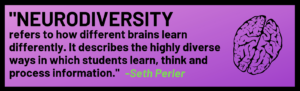
At its core, neurodiversity simply refers to the fact that human brains are different.
People think differently.
They learn differently.
They process information differently.
They feel differently.
They experience the world differently.
Human beings are extraordinarily complex.
Yet in education, we often try to simplify everything. We want to measure everything, quantify everything, rank everything, and compare everyone.
That can be dangerous.
Neurodiversity reminds us that different brains exist, and those differences matter.
The Iceberg Problem
One challenge with neurodiversity is that it’s often invisible.
We can’t see what’s happening inside someone else’s mind.
I often talk about the Iceberg Theory.
We only see the tip of the iceberg.
We see:
Falling grades
Frustration
Anger
Sadness
Missing assignments
Behavioral issues
But what’s underneath the surface?
That’s where the real story is.
In my work, finding out what’s beneath the surface is often the most important part.
Many neurodiverse students go unnoticed because their challenges aren’t obvious.
And when they struggle, adults often jump to conclusions:
“You’re lazy.”
“You’re not trying hard enough.”
“You need more discipline.”
“You need more motivation.”
The intentions behind these messages are usually good.
But over time, students begin to internalize them.
They start feeling shame.
And shame is incredibly corrosive.
It affects people deeply and can stay with them for years.
Different Doesn’t Mean Defective
Neurodiversity does not mean someone is bad.
It means they’re different.
Different isn’t a problem.
If anyone is dropping the ball, it’s often us as adults when we fail to meet the needs of neurodiverse students.
Neurotypical vs. Neuroatypical
You may hear related terms like:
Neurotypical
Neuroatypical
Neurodiverse
A neurotypical person generally develops and functions in ways that society considers typical.
A neuroatypical or neurodiverse person develops or processes information differently.
The problem is that education is often built around standardization.
We group students by age.
We teach the same curriculum.
We assign the same homework.
We expect students to move through material at the same pace.
We teach toward the middle of the bell curve.
But neurodiverse students are often the outliers.
And the reality is that people learn differently.
Asynchrony
Another important concept is asynchronous development.
Kids do not develop evenly across all areas.
Imagine a third grader who:
Does sixth-grade math
Reads at a high-school level
Has kindergarten-level handwriting
Has incredibly mature conversations with adults
But struggles emotionally when things don’t go their way
That’s asynchronous development.
Different skills develop at different rates.
Human development isn’t a straight line.
And when students don’t fit a standardized model, the worst thing we can do is blame them.
Strengths Matter
Ultimately, what we’re trying to do is help people build lives around:
Their strengths
Their interests
Their talents
Their passions
Their gifts
These are the things people build meaningful careers and meaningful lives around.
And those strengths vary tremendously from person to person.
That’s neurodiversity too.
Processing Differences
Many highly intelligent students have processing challenges.
When someone struggles with processing speed or information processing, they can appear unmotivated or disengaged.
But appearances can be misleading.
Sometimes students are trying extremely hard.
They’re simply working through information differently.
Unfortunately, those students are often misunderstood and shamed.
Twice-Exceptional (2e) Students
Another important term is twice-exceptional, often shortened to 2e.
A 2e student is gifted in one or more areas while also having learning challenges.
Those challenges might include:
ADHD
Autism
Dyslexia
Dyscalculia
Tourette syndrome
Sensory processing challenges
Trauma
Traumatic brain injuries
And often there is more than one exceptionality present.
This is sometimes referred to as comorbidity, meaning multiple conditions or diagnoses occur together.
What Do We Do About It?
The bottom line is simple:
People learn differently.
Therefore, people need to be taught differently.
We cannot use a one-size-fits-all, cookie-cutter approach and expect everyone to thrive.
This is where differentiation comes in.
Differentiation means adjusting instruction to meet individual needs.
It means:
Making accommodations
Making modifications
Listening to students
Asking what they need
Giving them ownership in their learning
I often call this creatively differentiated learning because it requires creativity, flexibility, and responsiveness.
The Challenges in Education
One reason this is difficult is that true differentiation requires time, resources, training, and support.
It’s hard to meet the needs of 35 highly diverse students in one classroom.
Teachers often want to do more, but they may not have the support, staffing, funding, or flexibility they need.
Educational systems are complex, and many factors influence how schools operate.
As a result, creating meaningful, individualized learning experiences can be challenging.
But that doesn’t mean we shouldn’t strive for it.
Bringing It All Together
So, after everything I’ve said, let’s return to the main point.
What are we really trying to do?
We’re trying to educate human beings.
We’re trying to help them:
Build on their strengths
Develop executive function skills
Pursue meaningful goals
Build healthy relationships
Feel seen and understood
Develop confidence
Create a great life now
Build a great future later
We want to honor their individuality.
We want to value their differences.
We want to recognize them as unique human beings.
And ultimately, we want them to shine.
That’s what neurodiversity is really about.
Again, my name is Seth Perler from SethPerler.com.
I hope this video gave you a sense—a vibe—of what neurodiversity means.
If you found it helpful, please share it with someone who might benefit from it. If you’re watching on YouTube, I’d love to hear your thoughts in the comments.
Go shine your light today, have a fantastic day, and I’ll see you soon.
The Executive Funciton Pack
Practical strategies for parents to help their child build motivation, independence, and confidence
Student Course
My step-by-step methods broken down for students
Coaching
Get executive function coaching support
Become an EF Coach
For teachers, tutors, parents who want to become a certified, profitable Executive Function Coach