Hey everybody, this is sethlesspurla.com, and this week I’m going to share with you a quick email from a parent. She writes: “My youngest, age 11, is challenged by organization. We’re working together to figure out some systems and tools to help align her success in this area.”
“Challenged by organization”—all right, look, 100% of the students that I work with are challenged by organization. They wouldn’t be coming to me if they weren’t challenged by organization. So I’m going to dive into this topic, and I’m going to make three videos for you.
This is part one, where I’m going to discuss three ways that you can really help tackle getting more organized and help kids who are challenged by organization.
Before we get into it, let’s look at why somebody would be challenged by organization in the first place. And what it comes down to is the brain—executive function in the brain, the prefrontal cortex, the front part of the brain. The brain’s ability to execute tasks. Organizing requires executive function; it’s part of the ability to execute a task. You must be able to organize things in order to execute a task.
So let’s look at two tasks: writing a paper and cleaning a bedroom. In order to do either of those, you have to organize. You have to organize your thoughts, organize your space, organize materials, organize clutter, organize stuff.
If you’re writing a paper, you have to organize the paper, organize your thoughts, do a good outline, do a good plan—which these kids do not like to do. They like to just start writing and vomit all their words out, and then it goes all over the place and is very disorganized.
And if you look at cleaning a bedroom, you have to organize space. You have to be able to think categorically and systematize, and think about where the places are for things.
What I’m going to do in these three videos is look at three things that you can do, either as a student to get more organized in life in general, or as a parent to help these students who are not organized.
Again, this has to do with the brain. The brain is still developing. The brain will continue to develop executive function until kids are about 25 years old. So there’s a lot of growth still happening, and the more you can help these kids build habits that support this, the better their executive function will develop.
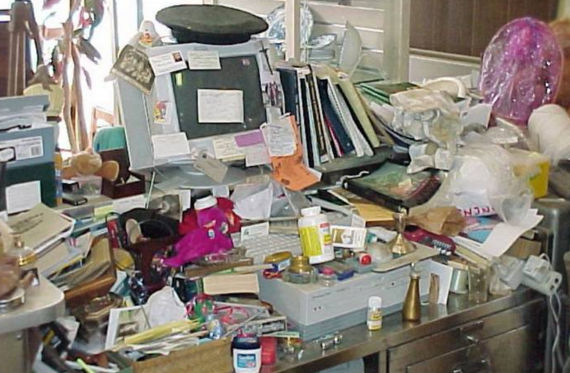
Today I’m specifically going to talk about the first tip to help people who are challenged by organization, and the first thing you want to do is declutter. You want to get rid of clutter. You want to minimize. You want to get down to the essentials. You want to get rid of everything you don’t need.
There are different domains you want to do this in. You want to go through all your stuff—closets, under the bed, old books, old toys, old things you don’t need anymore. You want to get rid of them.
A long time ago I met a guy named Lou. He was a multi-multi-millionaire. He lived in a big mansion in Indiana, and every once in a while he would have people over. This place was huge—four wings to the house.
One thing Lou said to me was that the more stuff you have, the more stuff you have to maintain. He had a lot of stuff. He even had someone living on the grounds just to maintain the lawn—literally someone whose job was just to maintain the exterior.
So the more stuff you have, the more you have to maintain. For these kids, the more stuff they have, the more they have to track—the more shoes, socks, clothing, books, toys, hobby equipment, whatever it is.
So your first step is to declutter. I’ll put a downloadable declutter checklist on the blog post for you so you can print it and use it to help you declutter in a systematic way so it’s not overwhelming.
When you don’t declutter, you are cluttering. And when there’s so much stuff, it creates not only clutter in physical space, but also clutter in the mind.
These kids who are not great at systematizing become even more overwhelmed mentally when there is a lot of physical clutter. It takes up mental space.
So you want to recycle it, give it to Goodwill, sell it, throw it away—whatever you need to do. Declutter.
That’s the first step. As you declutter, your mind begins to clear. As your space begins to clear, your mind begins to clear.
But it’s not just space and stuff—it’s also your computer. So I also want you to declutter your computer. That means getting rid of emails, unsubscribing from email lists, deleting any photos you don’t need.
So many people have thousands of photos—like 17 photos of the same thing. Get rid of it. Declutter that stuff.
Teach kids to do this early so they’re not gumming up their minds, space, and computers with unnecessary stuff. People are on so many email lists.
I was working with a student the other day. We were going through his email—he had about 7,000 emails. We unsubscribed from a lot of lists. He was into snowboarding, and there were hundreds of emails from companies he had never opened. So we deleted and unsubscribed.
So you really want to think about three things: decluttering physical space and stuff, decluttering your computer (very important in today’s technological world), and decluttering your mind.
When you do these things, it helps declutter your mind. But also, when you resolve internal issues and conflicts, that also helps to declutter the mind.
If you like what I’m doing, share this video with someone—I’d really appreciate that. I’ll get on to the next video, but for now, go to the blog if you want and download that free worksheet checklist to help you declutter.
Have an awesome day. Take care.