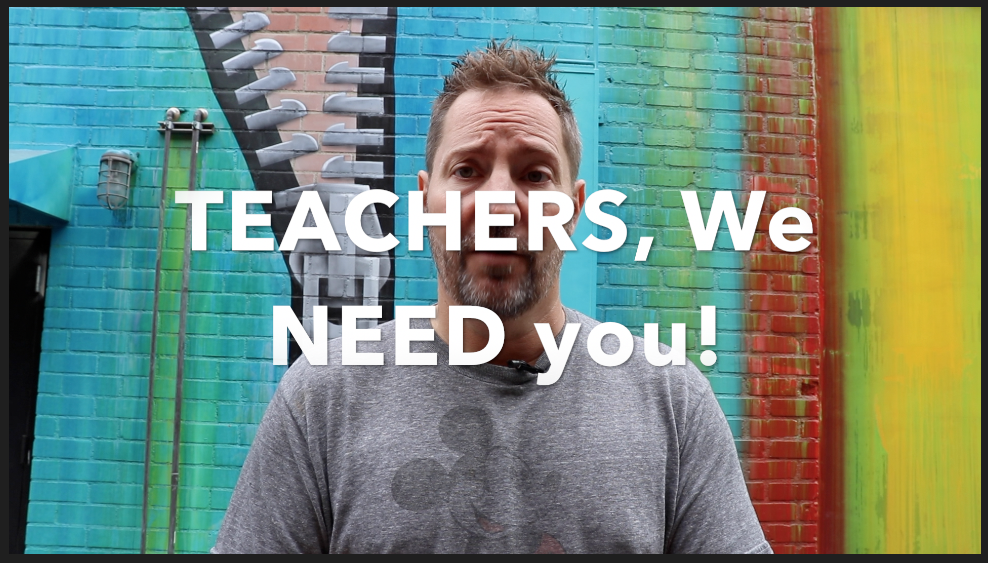
Hey, what’s up everybody? This is Seth from sethperler.com. I hope you are having a great day, coming to you from another paintastic wall in Santa Monica.
This is an email from Cynthia. Cynthia said:
“I am a special education teacher. I’m excited to have your resources to back up my suggestions for helping my high school students address their organization.”
Cynthia needed me to help back up her idea because oftentimes when teachers are doing non-traditional approaches, they are not getting the support or acceptance they need. Schools are often very “in the box,” and staff are often not pushing the needle or doing things differently. So teachers can feel very alone.
She appreciates that these resources give her an ally and another source of evidence to support her students.
She says her biggest challenge is working alone with little time and resources to support her awesome out-of-the-box learners. Parents, administrators, and even students have often given up by the time they reach her in high school. Those who have not given up often resist efforts to try something different because they are already jaded, exhausted, and beaten down by the system.
They’ve been through so much that they don’t feel noticed or supported. They often feel like nothing they do is enough. By high school, many are resistant and discouraged.
She thanked me for the support and shared that her biggest challenge is working alone.
So how do you overcome that feeling?
I think it’s very challenging. I went through the same thing. As a teacher, one of the most important things you need to do is listen to your gut. You are the professional.
Of course, the teaching profession has been “deprofessionalized.” Teachers are not always treated like professionals, or even like full human beings with lives outside of school. People often don’t see how much work goes into teaching—how much you take home, how much you work on weekends, summers, and breaks.
Many people don’t see that teachers are constantly working, thinking, and caring. So part of my advice is: trust your gut. You are the professional. You know your students in a different way than parents do. You know what they need.
If you have a sense that something will work for a student, try it anyway.
If you are feeling lonely, find community. Join a Facebook group for innovative teachers. Connect with others who are “disruptors” in a positive sense. Start a blog. Use Meetup. Find a small group of people you can connect with in a meaningful way.
Not in a complaining way—not just venting in the teachers’ lounge—but real dialogue, support, and collaboration. People who help you feel less alone and more connected in doing this work.
We need teachers like you. Society needs you.
Another piece of advice: ask your students what they need.
Here is a tool I use often called a “temperature check.”
I’ll ask a student:
“How’s your temperature with math today?”
“How’s your temperature with organization?”
“How’s your temperature with your social life?”
They give a number from 1 to 10. For example, if they say 7, I’ll ask:
“Why a 7?”
Then I’ll follow up:
“What would make it an 8?”
This helps them reflect in small, manageable steps. If a student says their day is a 1, I might ask, “What would make it a 2?”
These kinds of questions give me clear insight into what the student actually needs, straight from the source.
Even if you are not getting full support from the system, you can still know you are doing the right thing for the student’s growth and future. You can go to sleep knowing you are doing meaningful work, even if the system does not fully align with it.
We also have to remember that the system is old and often outdated. Education is supposed to prepare students for their future, but too often it does not fully succeed at that goal.
There are also large systems and companies involved in education that benefit from the status quo. That makes change difficult.
So teachers who think differently often face resistance.
But your job is to serve students—not systems, not companies, not testing organizations.
Teaching is an art. You are the artist. You design learning experiences that serve your students.
So keep trusting your professional judgment. Keep finding your community. Keep listening to your students.
Thank you for what you do. We need you.
Take care.